




Begin with a ground gas risk assessment to determine whether the site needs basic or enhanced protection. The level of risk will guide whether a membrane alone is suitable or whether it should be paired with ventilation or additional detailing.
Radon Barriers & Sub‑Floor Sealing Products
Gas Membranes & Accessories covers radon and ground gas barrier sheets along with the tapes, top hats and related components needed to create a continuous, gas tight layer at ground level. These products are commonly installed beneath concrete or screed in ground bearing slabs, suspended slabs, and raft foundations to limit the movement of radon, methane and carbon dioxide into a building. Many radon barriers are robust LDPE sheets that can also function as a damp proof membrane when correctly detailed, supporting compliance with UK guidance on contaminants and moisture.
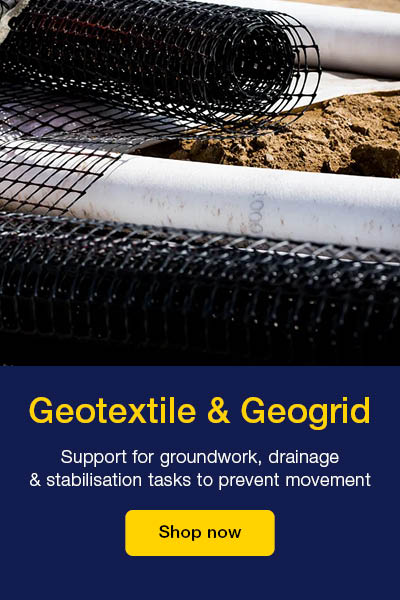
In installation, membranes are overlapped and sealed using butyl jointing tapes, while preformed top hats ensure a secure seal around service penetrations. Overlaps are typically set at around 150mm and pressed firmly to create an airtight, watertight joint; some systems also allow for welded seams depending on site requirements. Components found in Ducting help create safe and tidy service routes, and protective layers available in Geotextile & Geogrid are often used to reduce damage to the membrane during placement or concrete pours.
Selection and detailing of the Gas Membranes & Accessories range are informed by established UK guidance on radon and ground gas protection, which outlines the need for suitable materials, correct detailing and, where required, independent verification. Many products are aligned with damp proofing standards, and related systems in Waterproofing & Tanking or Damp Proof Membrane can be incorporated to manage moisture as well as ground gases. Together, the Gas Membranes & Accessories range supports reliable installation through compatible tapes, preformed units and clear detailing principles.
Gas Membranes & Accessories FAQ's
Look for products that follow recognised UK guidance for radon, methane and carbon dioxide protection. Many membranes also meet EN13967 where they act as a damp proof membrane.
Membrane sheets are typically overlapped by around 150mm. The joint surfaces should be clean and dry before applying double sided butyl tape, followed by firm rolling to ensure a complete seal. A foil or lap tape may be applied over the top, or seams may be welded if required.
Pre-formed top hats should be fitted over the pipe or duct, sealed to the membrane with compatible tape and secured with the supplied clip. This maintains continuity and prevents gas ingress at service points.
Verification may include visual checks and integrity testing depending on the site’s ground gas conditions. Independent inspection is often recommended to confirm the membrane has been installed correctly.