



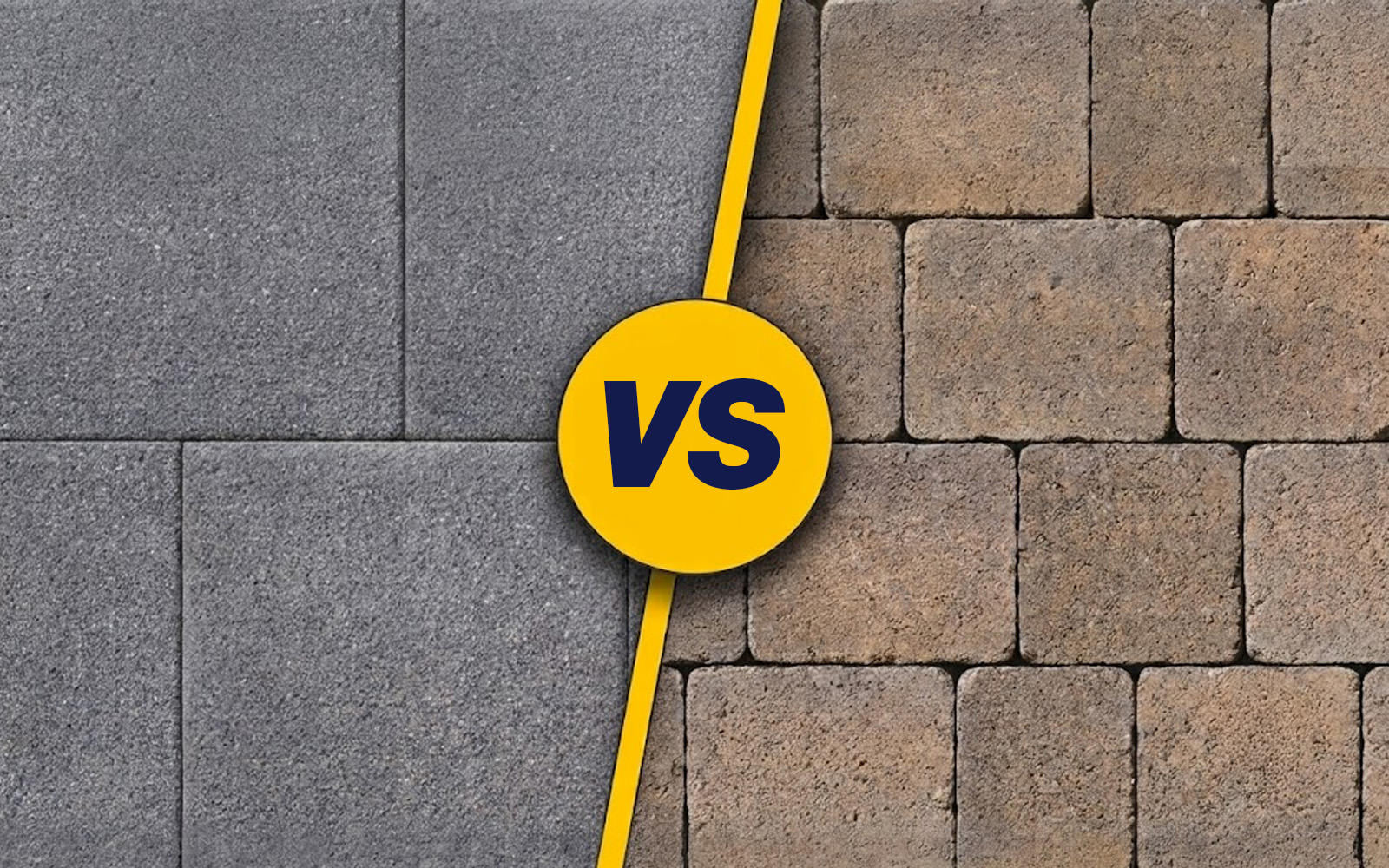
Block Paving vs Paving Slabs: Which Is Best for Your Patio or Driveway?
Block paving and paving slabs are the two most popular hard landscaping choices in NI. And the difference between them isn’t just looks. The right choice depends on what you’re paving (patio or driveway), how it’ll be used (foot traffic or vehicles), how much you want to spend, and how much maintenance you’re willing to do.
This guide compares them head-to-head: cost, appearance, durability, installation, maintenance and where each one is the better choice. By the end you’ll know which way to go for your project.
The short answer
Use block paving for driveways and high-traffic paths. It’s designed to spread vehicle load and is easy to lift and re-lay if you ever need to access services underneath. Use paving slabs for patios, terraces and pedestrian paths. They look more modern, install faster, and are easier to keep clean. Especially in NI’s damp climate.
At a Glance: Block Paving vs Paving Slabs
| Factor | Block Paving | Paving Slabs |
|---|---|---|
| Best for | Driveways, high-traffic paths | Patios, garden paths |
| Typical size | 100 x 200mm | 600 x 600mm / 800 x 400mm |
| Cost per m² (materials) | £25 – £55 | £20 – £80 |
| Install difficulty | Moderate | Easier (fewer pieces) |
| Install time (40m²) | 3–4 days DIY | 1.5–2 days DIY |
| Vehicle weight | Excellent | Limited (large porcelain on full mortar bed only) |
| Weed/moss issues | Higher (many joints) | Lower (fewer joints) |
| Cleaning | Moderate effort | Easy |
| Repair | Easy. Lift and replace individual blocks | Harder. Cracked slabs need full removal |
| Look | Traditional / textured | Modern / large-format |
Block Paving: Strengths and Weaknesses
Block paving is the right choice for driveways and any surface that needs to take vehicle weight. The small individual blocks (typically 100 x 200mm) lock together under a load and spread the force across the whole area. It’s also the easiest hard surface to repair. Pull up a single block, lay a new one, done.
Where block paving wins
- Driveways: Designed to carry vehicle weight without cracking. The de facto choice for residential driveways across the UK and NI.
- Curves and intricate shapes: Small units can be cut to follow curved boundaries cleanly. Slabs require more careful cuts on a curve.
- Repair access: If a utility pipe runs under your drive, lifting a few blocks to access it is straightforward. Lifting bedded slabs is a far bigger job.
- Heritage and traditional looks: Tumbled or brindle block paving looks at home with period properties. Modern porcelain looks contemporary by contrast.
Where block paving struggles
- Moss and weeds: All those joints are an invitation. Even with kiln-dried jointing sand or polymeric sand, expect to weed annually.
- Settlement and dipping: On a poorly prepared sub-base, blocks settle individually. A patchy, uneven driveway needs the whole section relifted.
- Skill to lay well: Getting the bond pattern, cuts and joint width consistent across a large area takes practice. Many DIYers underestimate this.
Paving Slabs: Strengths and Weaknesses
Paving slabs. Particularly modern large-format porcelain. Are the right choice for patios, terraces and pedestrian paths. They look contemporary, have far fewer joints to maintain, and install much faster than block paving. The catch is they aren’t designed for vehicle loads.
Where paving slabs win
- Modern aesthetics: Large-format porcelain looks clean and contemporary in a way block paving can’t match. The current preference for most new-build NI gardens.
- Faster install: Fewer, bigger pieces means a 40m² patio that takes 3–4 days in block paving can be done in 1.5–2 days in slabs.
- Easier maintenance: Fewer joints, less moss, less weeding. Porcelain in particular is virtually maintenance-free in NI’s climate.
- Cleaner look in small spaces: Block paving in a 3m x 3m courtyard looks chopped up. Three large slabs look intentional.
Where paving slabs struggle
- Vehicle loads: Standard paving slabs crack under car wheels unless laid on a full mortar bed with a deep sub-base. And even then, large-format slabs are vulnerable to point loading.
- Cost at the premium end: Top-tier porcelain can hit £80 per m². Twice the price of mid-range block paving. The maintenance savings recoup it over time.
- Cracked slabs are a bigger fix: Crack one slab and you’re lifting, cutting and rebedding a 600 x 600 panel. Crack one block and it’s a 5-minute job.
Cost: Block Paving vs Slabs
Material cost is only part of the picture. Labour (or DIY time) makes up roughly half of any paving job. Below is a rough cost comparison for a 40m² installation in NI.
| Item | Block Paving (40m²) | Paving Slabs (40m²) |
|---|---|---|
| Materials (mid-range) | £1,400 – £1,800 | £1,800 – £2,800 |
| Sub-base (MOT Type 1) | £250 – £350 | £250 – £350 |
| Bedding sand / mortar | £100 | £200 (mortar) |
| Jointing material | £50 (kiln-dried sand) | £80 ( jointing compound ) |
| DIY time (weekend days) | 3–4 days | 1.5–2 days |
| DIY total cost | £1,800 – £2,300 | £2,330 – £3,430 |
| Professional install | £3,500 – £5,000 | £3,200 – £5,500 |
Block paving is generally cheaper on materials but more time-consuming. Paving slabs are quicker to install and need less ongoing maintenance, which can tip the long-term economics in their favour.
Which Is Best for Your Project?
Choose block paving if…
- You’re paving a driveway or any surface that takes vehicles.
- The area is curved or has intricate shapes to follow.
- Services run underneath and may need future access.
- You want a traditional or heritage look that suits a period property.
- You’re prepared to weed and refresh jointing sand every couple of years.
Choose paving slabs if…
- You’re building a patio, terrace or back-garden path.
- You want a modern, contemporary look with minimal joints.
- You want to minimise ongoing maintenance. Porcelain especially.
- Speed of installation matters.
- You’re working in a small or compact garden where large-format units look better.
Can You Use Slabs on a Driveway?
Technically yes. Large-format porcelain can be installed on a driveway, but it needs a much deeper sub-base (150–200mm of MOT Type 1), a full mortar bed under every slab, and proper expansion provision. The cost increases significantly, and slabs are more vulnerable to point loads from car jacks, stiletto heels, or dropped tools than block paving. In practice, almost every driveway in NI uses block paving for good reason.
Common Mistakes to Avoid
- Using paving slabs on a driveway without specialist build-up: Cracked slabs within 12 months. Use block paving instead, or accept the extra cost and complexity of a heavy-duty slab installation.
- Skipping the sub-base: Both block paving and slabs need 100mm minimum compacted MOT Type 1. Driveways need 150mm. No sub-base = movement and cracking.
- Wrong jointing material: Block paving uses kiln-dried sand or polymeric sand. Paving slabs use mortar or proprietary jointing compound. Don’t mix them up.
- Not allowing drainage: Both options need a fall of 1:60 away from the house. In NI, factor in permeable paving rules for new driveways over 5m².
Frequently Asked Questions
Both can last 25+ years if properly installed. Porcelain slabs typically outlast concrete slabs and block paving in NI’s wet, frost-prone climate. Block paving can be relaid easily if sections sink.
Material cost: block paving is generally cheaper. Total install cost: slabs can work out similar once you account for the time saved. Premium porcelain slabs are the most expensive option.
Not directly. You need to remove the old patio, prepare a proper sub-base, and re-lay. Layering blocks over old slabs causes drainage problems and uneven settlement.
Polymeric jointing sand. It’s more expensive than kiln-dried sand but locks in place, resists weeds far better, and stays in the joints during heavy NI rainfall.
Permeable surfaces (block paving with permeable jointing, gravel) don’t need planning permission. Impermeable surfaces over 5m² require planning permission unless surface water drains to a permeable area on your own land.
Get Your Paving from MacBlair
MacBlair stocks block paving, porcelain and concrete slabs, sub-base materials, jointing sand and compounds, and all the tools you need to lay them. Our team across NI can help you choose the right material for your project. Patio or driveway. And calculate exact quantities.